No More "I'm Bored!" Cries: Your Sanity-Saving Guide to Indoor Activities for Kids
Stuck indoors with restless kids this summer vacation? Discover 100+ simple, budget-friendly activities using items you already have at home. Plus summer holiday boredom busters, energy-burning activities, DIY projects, and independent play strategies.
Table of Contents
The best indoor activities for kids require no expensive toys—just cardboard boxes, kitchen items, and household fabrics. Children engaged in hands-on, screen-free play show better attention spans, improved problem-solving skills, and stronger social development. This guide includes 100+ activities organized by type, age, and energy level.
Last Updated: April 2026 | Based on research from the American Academy of Pediatrics, National Institutes of Health, and Montessori educational principles. Updated with summer vacation 2026 activity ideas.
Summer vacation is here, and if you're reading this in April or May, you already know the drill. Six weeks of "I'm bored" on repeat, 40°C heat outside making parks unusable until evening, and a child with the energy of a thousand suns trapped inside a 2BHK apartment. I could practically hear the countdown to a full-blown meltdown.
We'd already cycled through all his regular toys by Day 3 of summer holidays, and the walls of our home felt like they were closing in. I'm sure you've been there — whether it's summer vacation, a rainy monsoon day, or just a regular weekend.
Here's the thing. Keeping our little ones engaged indoors, especially when you're juggling space constraints and the very real desire to not just plonk them in front of a screen, is a proper challenge. Research from the National Institutes of Health shows that excessive screen exposure can affect children's sleep quality and cognitive development. The American Academy of Pediatrics recommends that children ages 2-5 have no more than 1 hour of screen time per day, and that active play should take priority.
You don't need fancy, expensive toys or elaborate setups that take an hour to prepare for five minutes of play. The Montessori approach to independent play emphasizes using simple, everyday materials that let children explore at their own pace. You just need a few solid, go-to indoor activities for kids that are simple, actually work, and don't require a trip to a specialty store. These are the tricks I've picked up along the way, the real stuff that helps us navigate those long, cooped-up days. (And if you're also struggling with getting kids to wind down at bedtime, we've got you covered there too.)
Fun, Simple, and Screen-Free Ideas
The most engaging indoor activities for kids fall into five categories: building (forts, blocks), sensory play (textures, water), movement (obstacle courses, dance), pretend play (shops, restaurants), and creating (art, crafts). Rotate between these categories to keep children engaged. Most require only items you already have: cardboard boxes, bedsheets, kitchen containers, and basic art supplies.
Think of this as your emergency toolkit for summer vacation days, rainy monsoon afternoons, unexpected holidays, or just those times when "I'm bored" is on repeat. During the Indian summer (April-June), when it's too hot to play outside before 5 PM, these indoor activities become absolute lifesavers.
1. The Great Indian "Fort" Expedition
There's something magical about building a fort. It's a classic for a reason! Drape a couple of old sarees or bedsheets over some chairs, throw in some pillows and cushions, and you've created a whole new world.
For a 3-year-old, it's a secret cave. For a 7-year-old, it's a spaceship. We arm our little one with a torch and some storybooks, and he's sorted for a good while. It's one of the best indoor activities because it feels so cosy and safe inside. Speaking of stories, building a love for reading starts with exactly these cozy moments.
Want similar fort-building ideas for your child's age group? Check out our physical activities collection or Login to KidCompass to discover personalized activities that work with your space and materials.
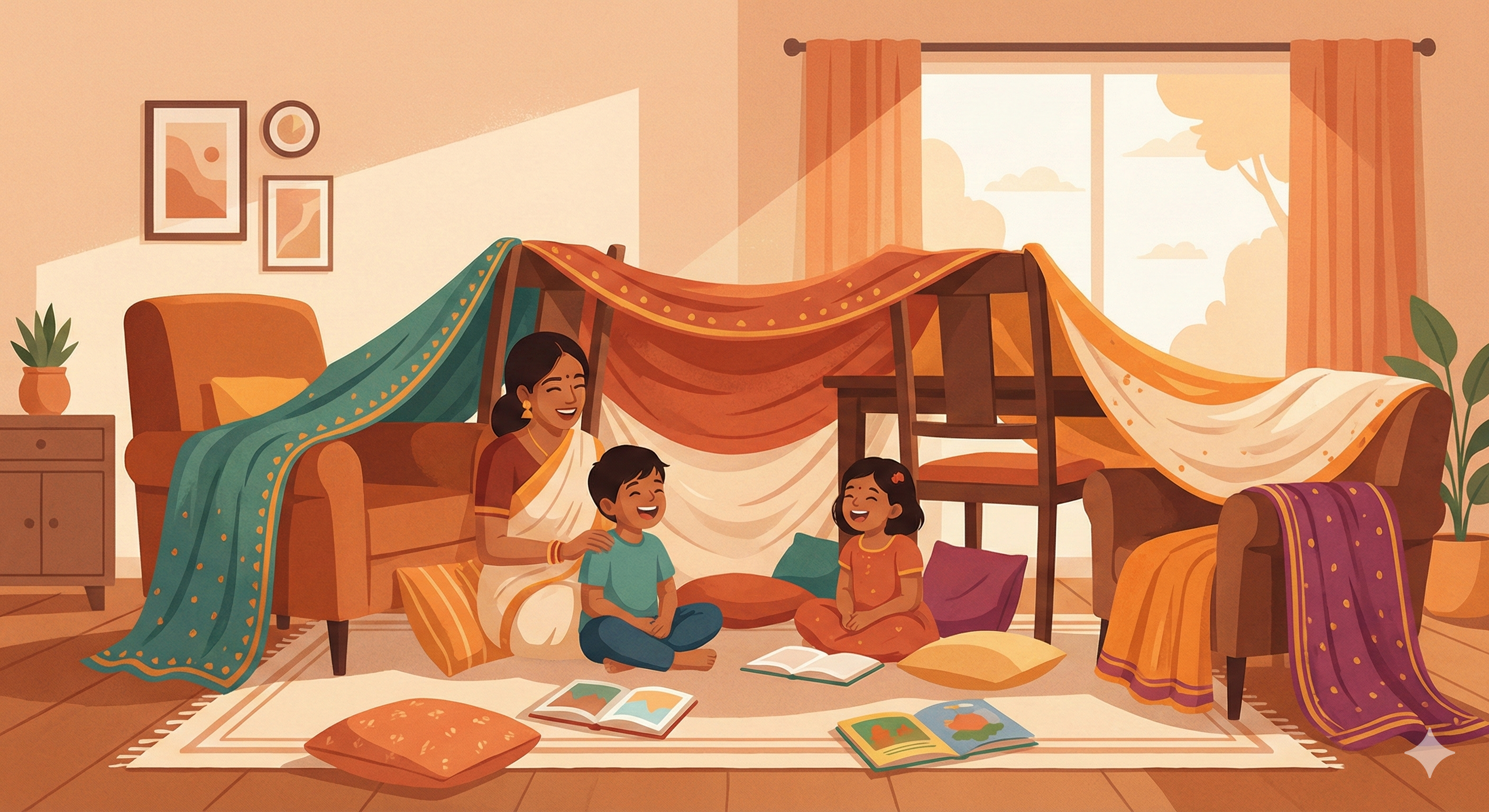 Indian family building a cozy blanket fort with sarees and cushions in their living room
2. Kitchen Helpers to the Rescue!
I used to think having my toddler in the kitchen was a recipe for disaster. But honestly, it can be a fantastic way to keep them occupied. I'm not talking about complex baking. Think simpler.
Let your 5-year-old mix the ingredients for bhel puri or help shell peas. My little one loves spreading jam on a roti or arranging slices of cucumber on a plate. It's a brilliant sensory activity and helps with their fine motor skills. Plus, they're much more likely to eat something they've helped "cook." Try our Veggie Stamp Masterpieces activity using ladyfinger (okra) or potato halves to create beautiful prints!
This connects beautifully with our Creative Chapati Stamp Art activity where toddlers can make patterns in chapati dough using everyday kitchen tools. For older kids, try the Mystery Box Chef Challenge where they create dishes from surprise ingredients!
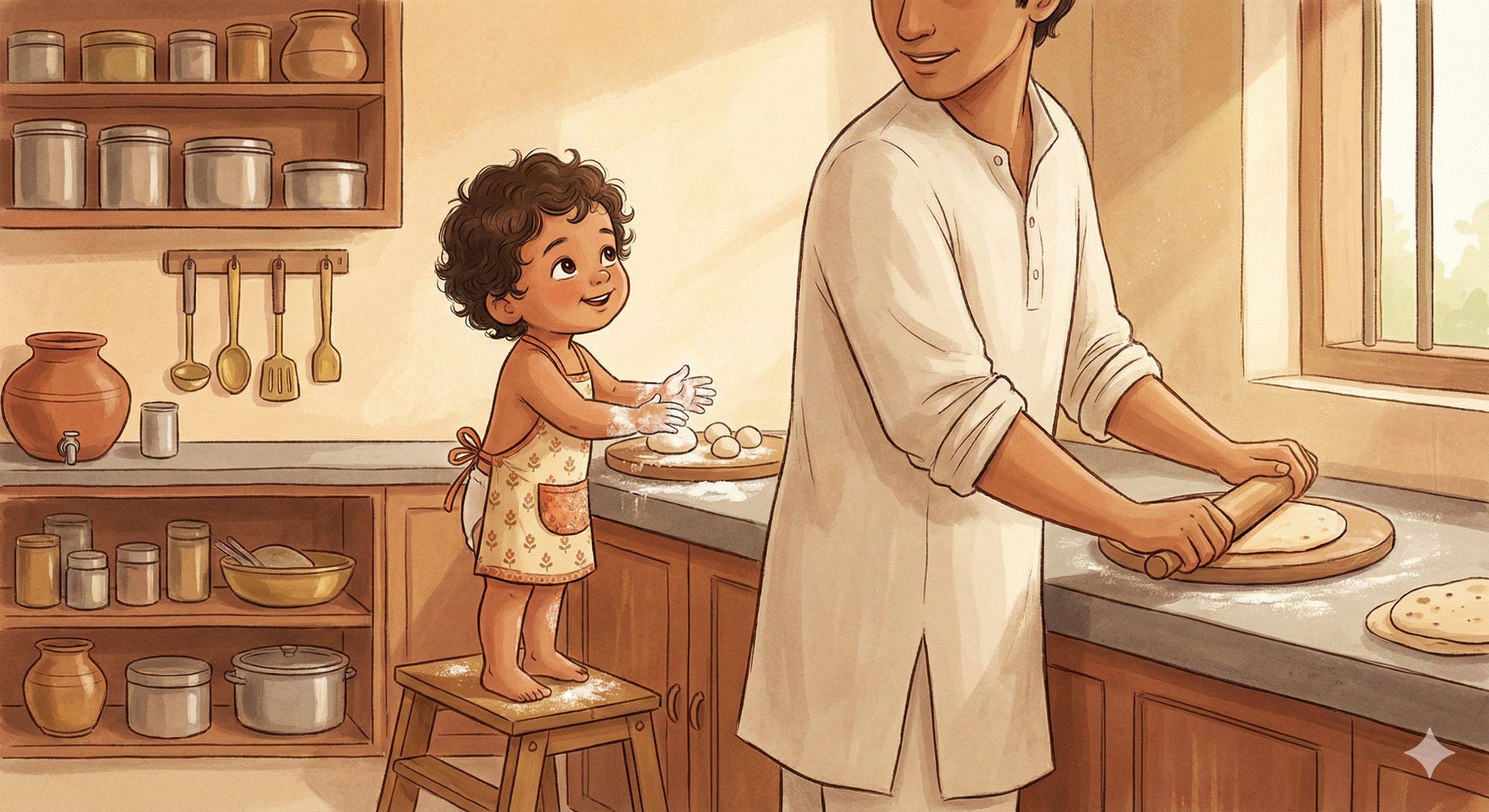 Young child helping make rotis in an Indian kitchen, rolling dough balls with flour-covered hands
3. The Humble Cardboard Box Transformation
Never, ever throw away a big cardboard box. It's a blank canvas for imagination. With a few sketch pens from the local stationery shop, a box can become a car, a house, a robot, or a shop counter.
We once spent an entire afternoon turning a carton into a bus. He was the driver, and all his soft toys were the passengers. It costs nothing but provides hours of creative play. It's one of those perfect screen-free ideas that lets their imagination do all the work. For more creative projects, check out our art activities like Dream City Designers or Comic Book Creators' Workshop.
4. Create an Indoor Obstacle Course
When the wiggles get too much to handle, an obstacle course is your best friend. This sounds more complicated than it is. Line up some pillows to jump over, create a tunnel by draping a dupatta between two stools, and use buckets to weave around.
The goal is to get all that energy out without breaking anything! It's fantastic for gross motor skills and can be adapted for different ages. For a toddler, it might just be crawling under a chair, while an older child might have to balance a book on their head. Try the Tightrope Walker Challenge or Speedy Lemon Balance Race for balance-focused fun.
This reminds me of our Monkey Jump Adventure activity where kids hop across "rocks" (pillows) to cross an imaginary river. The Freeze Dance Fun is another great energy-burner that works in small spaces!
5. The Magic of a "Treasure Hunt"
This one requires a little bit of prep, but the payoff is huge. Hide a few of your child's favourite small toys or even a tasty snack around the living room.
For younger kids (ages 2-4), you can give simple verbal clues like, "It's hiding behind something soft you sit on." For older children (ages 5-8), you can draw a simple map or write picture-based clues like our Pirate's Secret Treasure Map activity. It turns the familiar space of your home into an exciting adventure zone and is great for their problem-solving skills. The Rice Bowl Treasure Hunt is a sensory twist on this classic game.
6. Old-School Fun with Puppets
You don't need fancy puppets. An old sock with buttons for eyes or even paper bags with faces drawn on them work perfectly. You can create characters from their favourite Panchatantra story or just make up silly ones.
Put on a little show behind the sofa. The best part is when they want to take over and create their own stories. This is a wonderful way to encourage storytelling and communication. For more storytelling ideas, try the Amazing Adventure Story Chain or Magic Story Stone Adventures.
7. Kitchen Band Session
Here's where you can make some noise! Gather different containers. A metal bowl, plastic container, wooden cutting board. Give your little one a wooden spoon and let them discover how different materials create different sounds.
Our Kitchen Jam Session activity takes this further with rhythm patterns and music exploration. The Pots & Spoons Orchestra is another favorite from our music activities collection.
Making It Work for Your Family
Now, let's be real. What works one day might totally flop the next.
For the really little ones (2-3 years old): Keep it simple and sensory-based. A tray with some dal or rice for scooping and pouring can be surprisingly engaging -just like our Rice Bowl Treasure Hunt. Or a "dance party" with Magical Mirror Dance where you just put on some music and jump around together is a great way to burn off that toddler energy. The Balloon Butterfly Chase is another toddler favourite that's gentle yet engaging.
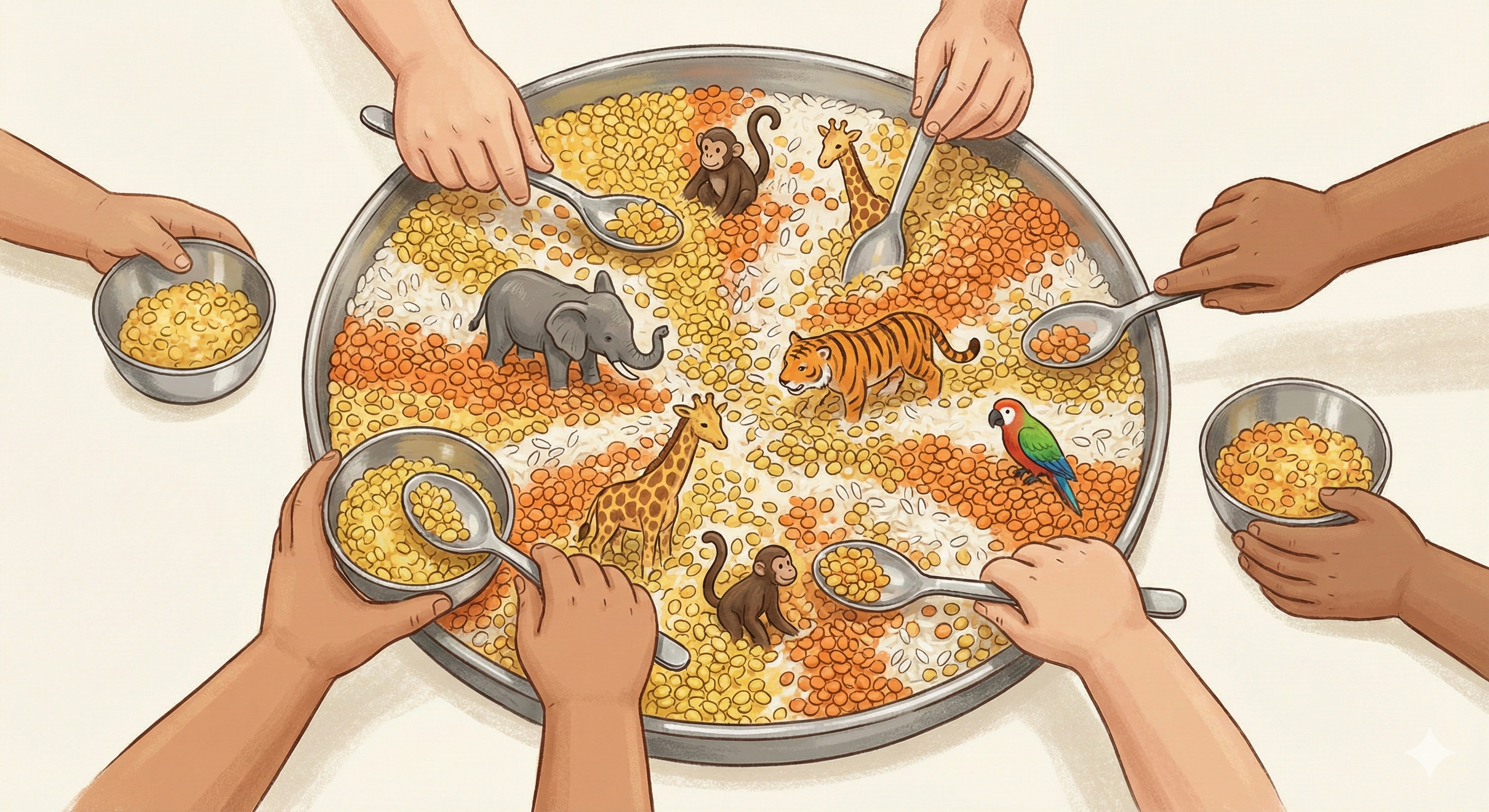 Sensory play setup with colorful dal and rice in a steel thali, small hands scooping with spoons
When extended family is over: Get everyone involved! A game of indoor "bowling" with Backyard Bowling Bonanza using empty plastic bottles and a soft ball can be hilarious with grandparents cheering on. Or turn storytelling into a group activity with Family News Flash where each person adds a sentence. The Animal Sounds Safari is perfect for getting grandparents and cousins involved in silly fun!
When it's too noisy outside: Sometimes the construction work or traffic gets overwhelming. That's when quiet indoor activities become essential. Try the Super Memory Challenge or Word Tower Builders for calmer moments. The Super Sock Detective game is another quiet activity that keeps kids focused and engaged. For creative quiet time, the Colorful Pattern Rangoli Fun activity brings traditional Indian art into your home.
The key is not to aim for perfection. It's about connection. It's about finding small ways to turn a potentially stressful day into a chance for a little bit of fun and bonding. Some days will be noisy, messy, and chaotic, and that's perfectly okay.
So next time you're stuck indoors with a restless child, take a deep breath. You've got this. Try one of these simple ideas. You might be surprised at how a humble cardboard box or a couple of old sarees can completely save the day.
Summer Vacation Activities (Your 6-Week Survival Guide) {#summer-activities}
Indian summers (April-June) present a unique challenge: kids are home all day, it's too hot to go outside until evening, and six weeks of vacation stretches endlessly. The key is creating a loose daily rhythm — not a rigid schedule, but a rotation between active play, creative projects, quiet time, and helping around the house. Children thrive on predictability, even during holidays.
Summer vacation doesn't have to mean defaulting to screens for six weeks. Here's how to structure your days:
The Summer Day Framework
| Time Block | Activity Type | Examples |
|---|---|---|
| Morning (before it gets hot) | Active play + energy burn | Obstacle courses, dance parties, Monkey Jump Adventure |
| Late morning | Creative projects | Cardboard crafts, painting, Dream City Designers |
| Afternoon (peak heat) | Quiet indoor time | Reading, puzzles, audiobooks, Super Memory Challenge |
| Evening (after 5 PM) | Outdoor play or water play | Balcony gardening, evening walks, water games |
Summer-Specific Indoor Activities
- Mango activities — sort mangoes by size, make aam panna together, mango seed art (wash, dry, paint)
- Ice play station — freeze small toys in ice trays, let kids "rescue" them with warm water (perfect cooling activity)
- Indoor water play — tubs on the bathroom floor, cups, funnels, and food coloring
- Summer reading corner — set up a cozy nook with new library books for the vacation (see our summer reading guide)
- Vacation journal — daily drawing + one sentence about what they did (builds writing habits too)
- Lemonade stand — practice math, social skills, and entrepreneurship in one activity with Business Tycoon Challenge
- Indoor camping — pitch a bedsheet tent, pack "trail snacks," tell stories by torchlight
Beating the "I'm Bored" Summer Loop
By Week 2 of summer vacation, you'll hear "I'm bored" even though the house is full of toys. This isn't a failure — it's actually a sign of healthy development. Boredom pushes children toward creative problem-solving.
The Summer Boredom Jar: Write 30+ activities on chits of paper (use ideas from this guide). When they say "I'm bored," they pick a chit. The rule: they must try it for 10 minutes before picking another. Most kids get engrossed within 5 minutes.
Rainy Day Activities (When You're Really Stuck Inside)
Rainy days are ideal for cozy activities that feel special: fort-building with flashlights, warm drinks with stories, and window-watching games. Don't assume rain means quiet activities only—children still need to burn energy through indoor movement like hallway bowling, mattress jumping (supervised), or dance parties.
There's something special about rainy days. The sound of rain, the cozy feeling of being inside — use it to your advantage.
Rainy Day Rituals That Work
| Activity | Why It Feels Special | Best Age |
|---|---|---|
| Window watching station | Set up cushions by window, spot vehicles, count raindrops | 2-4 |
| Chai and story time | Warm milk/chai + favourite book = cozy memories | All ages |
| Rain sounds dance | Dance to the rhythm of real rain | 3-6 |
| Paper boat races | Make boats, race in a bucket or bathtub | 4-8 |
| Thunder counting | Count seconds between lightning and thunder | 5-9 |
| Monsoon art | Paint what the rain sounds like | 4-8 |
Rainy Day Doesn't Mean Low Energy
Many parents assume rain = quiet activities. But kids still need to burn energy:
- Hallway bowling — Backyard Bowling Bonanza works indoors with plastic bottles
- Mattress jumping — if safe and supervised
- Indoor cricket — soft ball, rolled newspaper bat, cushion wickets with Mini Cricket Champions
- Dance party — Freeze Dance Fun with rain as background music
Energy-Burning Activities (When They Need to MOVE)
Children need at least 60 minutes of physical activity daily, according to the WHO. When stuck indoors, high-energy activities like animal races, pillow climbing, balloon keep-up, and sock skating can burn energy in 10-15 minutes. The "burn energy in 10 minutes" routine below works particularly well before homework, meals, or any activity requiring focus.
Some days, calm activities won't cut it. Your child is bouncing off walls, and you need to tire them out — without leaving the house.
High-Energy Indoor Activities
- Animal race — crab walk, bear crawl, frog jump across the room
- Pillow mountain climb — stack all cushions, climb and conquer
- Balloon keep-up — don't let it touch the ground, add more balloons for challenge
- Dance battle — take turns showing off moves, family judges
- Jumping jack countdown — start at 20, count down together
- Sock skating — slide across smooth floors in socks
- Tunnel crawl — chairs + bedsheet = tunnel to crawl through fast
- Indoor relay — run to bedroom, touch wall, run back, tag sibling
The "Burn Energy in 10 Minutes" Routine
When you need quick results:
- 20 jumping jacks
- Run in place for 30 seconds
- 10 frog jumps
- Spin in circles 5 times
- 5 burpees (kid version — squat, jump, hands up)
- Freeze and hold statue pose
Repeat 2-3 times. Works every time before homework, meals, or when you need them to focus.
Activity picks: Monkey Jump Adventure, Tightrope Walker Challenge, Speedy Lemon Balance Race
DIY Projects & Crafts (Beyond Basic Colouring)
Open-ended craft projects develop creativity and problem-solving more effectively than structured coloring books. Research on play-based learning shows that children who engage in maker activities develop stronger spatial reasoning and fine motor skills. The best DIY projects use recycled materials: cardboard boxes, plastic bottles, newspaper, and fabric scraps.
When they're ready for something more involved than drawing, try these maker projects.
30-Minute DIY Projects
| Project | Materials | Age | Link |
|---|---|---|---|
| Cardboard car | Box, paper plates, paint | 4-7 | — |
| Paper bag puppets | Paper bags, markers, yarn | 3-6 | — |
| Bottle shakers | Plastic bottles, dal, rice, tape | 2-5 | Kitchen Jam Session |
| Crown/tiara | Chart paper, glitter, rubber band | 4-7 | — |
| Binoculars | 2 toilet rolls, tape, string | 4-8 | — |
| Mailbox | Shoebox, paint, slot cut in top | 5-8 | — |
Longer Projects (1+ Hour)
For weekends or holidays when you have more time:
- Cardboard kitchen — multiple boxes, knobs from bottle caps, working "oven" door
- Puppet theater — large box, cut window, curtain from dupatta
- Marble run — paper towel tubes, tape, wall or cardboard base
- City diorama — Dream City Designers with boxes, paper buildings
- Comic book creation — Comic Book Creators' Workshop with stapled paper pages
Craft Supplies to Always Have
Keep these stocked and you'll never be stuck:
- Old newspapers and magazines
- Cardboard boxes (all sizes)
- Chart paper / construction paper
- Sketch pens, crayons, glue stick
- String, rubber bands, tape
- Old clothes for dress-up / cutting
Independent Play (When You Need 20 Minutes to Yourself)
Children play independently better after 10 minutes of focused attention from you. This "filling the cup" strategy works because children who feel connected don't constantly seek your attention. Set up "invitations to play"—materials laid out attractively that draw them in—and gradually build independent play time from 5 minutes to 20+ minutes over several weeks.
Every parent needs moments to cook, work, or just breathe. Here's how to set up play that doesn't require constant supervision.
Why Kids Struggle to Play Alone
| Reason | What's Happening | The Fix |
|---|---|---|
| Too many toys | Overwhelmed by choices | Offer 2-3 options only |
| Boredom habit | Expects entertainment from you | Gradual independence building |
| Seeks connection | Wants your attention | Fill their "attention cup" first, then step back |
| Doesn't know how | Never practiced solo play | Start with 5 minutes, build up |
Setting Up Independent Play Stations
Create "invitations to play" — set up materials that draw them in:
For ages 2-3:
- Sensory bin with dal and spoons on the floor
- Stacking cups or blocks ready to build
- Crayons and paper on low table
For ages 4-5:
- Playdough with cookie cutters laid out
- Dress-up clothes in accessible basket
- Simple puzzle with pieces spread out
For ages 6-8:
- Building challenge: "Make the tallest tower before the timer"
- Drawing prompt: "Draw what you want for dinner"
- Pirate's Secret Treasure Map to solve independently
The "Filling the Cup" Strategy
Kids play independently better AFTER focused connection time.
- 10 minutes of full attention — no phone, follow their lead in play
- Announce transition — "I need to cook now. You can keep building."
- Stay nearby — same room but doing your task
- Praise independence — "I love how you figured that out yourself!"
Activities That Work Without You
- Super Memory Challenge — can play solo, flipping cards
- Colorful Pattern Rangoli Fun — meditative, focused activity
- Word Tower Builders — building with any blocks
- Audiobook + colouring — hands busy, mind engaged
- "Cleaning" — spray bottle with water + cloth = productive play
100 Rapid-Fire Screen-Free Ideas for Indian Kids
Below are 100 activities that cost almost nothing, require no advance preparation, and use items found in most Indian homes: dal, rice, old sarees, cardboard, and basic kitchen items. Organized by category so you can quickly find what matches your child's current mood and energy level.
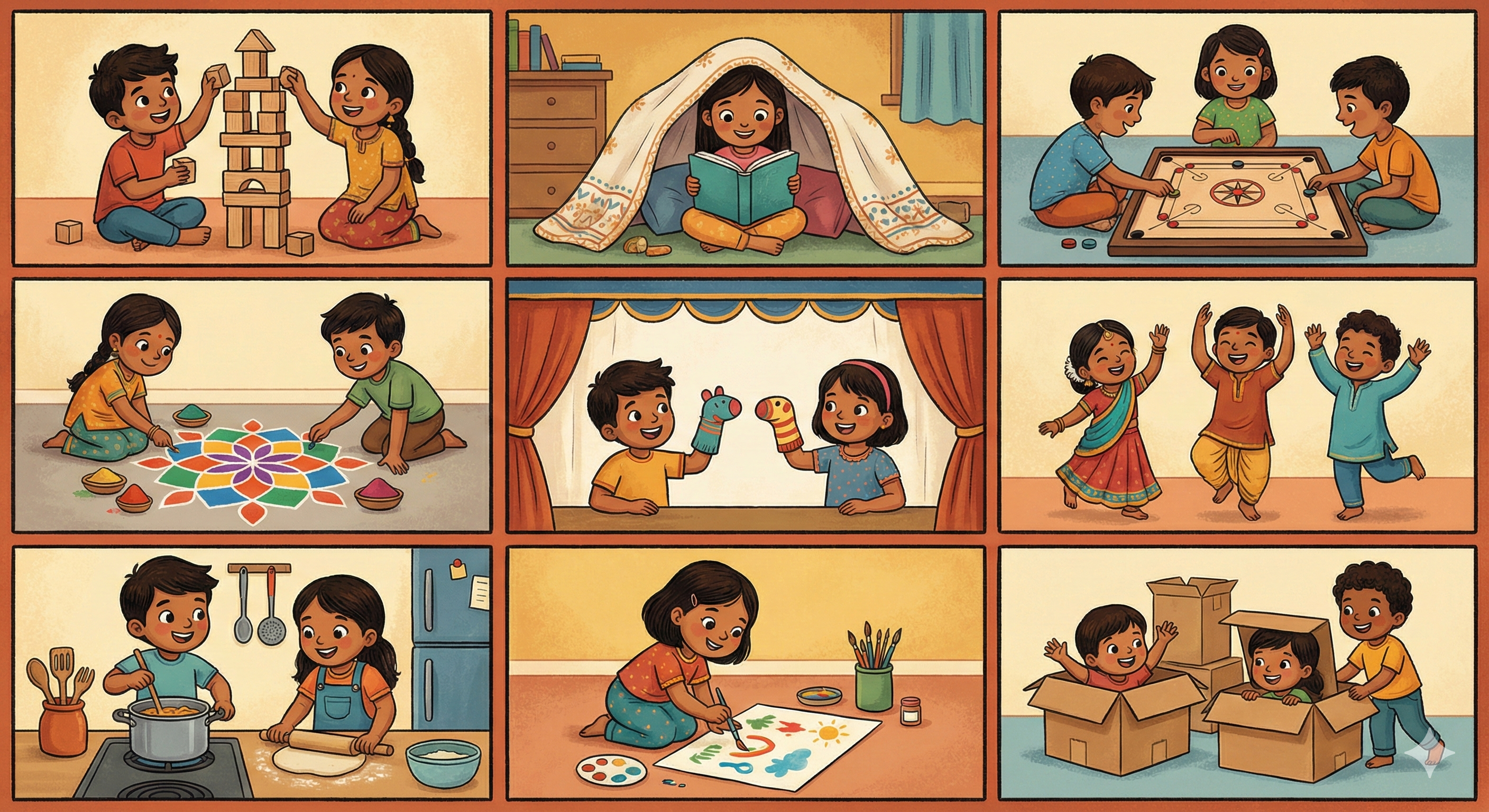 Grid of Indian children doing various indoor activities - building blocks, reading, rangoli, dancing, crafts
Kitchen Play (15 Ideas) {#kitchen-play}
Explore our sensory activities for more kitchen-based play ideas.
- Sorting dal by colour (moong, masoor, chana) - like Rice Bowl Treasure Hunt
- Rolling chapati dough balls - see Creative Chapati Stamp Art
- Washing vegetables in a tub
- Arranging biscuits on a plate in patterns
- Peeling boiled eggs or garlic cloves
- Mixing atta dough (supervised)
- Decorating idlis with chutney dots
- Creating faces on dosa with vegetables
- Counting and sorting spices into small bowls
- Making lemonade (squeezing, stirring, pouring)
- Cookie cutter shapes in bread slices
- Arranging a fruit chaat platter
- Grinding spices with a small mortar-pestle
- Kneading dough for parathas
- Creating "soup" with water and safe kitchen items
Sensory Play (15 Ideas) {#sensory-play}
Browse all our sensory activities for age-appropriate sensory play.
- Rice or dal sensory bin with hidden toys - try Rice Bowl Treasure Hunt
- Water play with cups, funnels, and spoons - see Thirsty Plants Water Mission
- Atta (flour) drawing tray
- Shaving cream finger painting (supervised)
- Ice cube rescue -free frozen toys with warm water
- Playdough from atta and food colouring
- Bubble wrap stomping
- Cotton ball texture exploration
- Sand tray letter writing
- Wet sponge squeezing and transferring
- Feather tickle sensory game
- Scented playdough with haldi, jeera
- Fabric texture sorting (silk, cotton, wool)
- Cornflour slime (cornflour + water)
- Warm water foot soak with flower petals
Physical Play & Movement (15 Ideas) {#physical-play}
Explore all our physical activities for active indoor play.
- Indoor hopscotch with masking tape - try Number Hop Challenge
- Balloon volleyball over a dupatta "net" - see Balloon Butterfly Chase
- Pillow lava -floor is lava with cushions
- Animal walks (crab, bear, frog) across the room
- Yoga poses with animal names
- Simon Says in Hindi/English mix
- Musical statues with Bollywood songs
- Tunnel crawl under chairs and tables
- Balancing a book on head while walking
- Indoor bowling with plastic bottles
- Sock skating on smooth floors
- Jumping jack counting challenge
- Hula hoop (or dupatta twirling)
- Mattress jumping (if safe)
- Freeze dance with sudden music stops
Creative Arts & Crafts (15 Ideas) {#arts-crafts}
Browse all our art activities for creative projects.
- Rangoli with flower petals or coloured rice - try Colorful Pattern Rangoli Fun
- Mehendi patterns on paper with brown markers - see Veggie Stamp Masterpieces
- Leaf printing with paint
- Paper plate masks (animals, superheroes)
- Newspaper boat and hat folding
- Bindi art patterns on paper
- Bangles tracing and colouring
- Cotton ball cloud pictures
- Hand and foot print art
- Paper chain garlands (for festivals)
- Diya decoration with glitter and paint
- Rakhi making with thread and beads
- Greeting cards for grandparents
- Magazine collage art
- Stone painting (collect from outside)
Quiet Time Activities (12 Ideas) {#quiet-time}
Perfect for winding down - see our reading activities and bedtime routine guide.
- Picture book exploration (even without reading) - supports building a love for stories
- Puzzle solving (age-appropriate) - try Super Memory Challenge
- Sticker books and sticker scenes
- Colouring books with crayons
- Threading beads onto string
- Matching card games (memory)
- Looking at family photo albums
- Drawing family members
- Tracing shapes and letters
- Playing with building blocks quietly
- Sorting buttons by colour/size
- Listening to audio stories
Imagination & Pretend Play (12 Ideas) {#pretend-play}
Pretend play builds social skills - see My Awesome Shopkeeper Adventure and math activities.
- Doctor-doctor with stuffed toys as patients
- Restaurant/dhaba serving pretend food - try Mystery Box Chef Challenge
- School-school (child as teacher)
- Train journey with chairs in a row
- Shop-keeper with empty grocery boxes
- Post office delivering "letters"
- Hair salon with dolls
- Mechanic fixing toy vehicles
- Pilot flying a cardboard airplane
- Chef in a cardboard kitchen
- Veterinarian caring for stuffed animals
- News reporter with a pretend microphone
Traditional Indian Games (10 Ideas) {#traditional-games}
Traditional games build patience and strategy - see our guide on teaching kids to wait their turn.
- Gilli-danda (indoor version with rolled newspaper) - for coordination see Mini Cricket Champions
- Chaupar/Pachisi with homemade board - builds math skills like Pirate's Secret Treasure Map
- Carrom practice (finger flicking skills)
- Lagori with soft balls and stacked cups
- Kho-kho in the corridor
- Stapoo (hopscotch) variations
- Pitthu with plastic glasses and soft ball
- Lattu spinning (if you have one)
- Gutte (five stones) with pebbles or beads
- Raja Mantri Chor Sipahi card game
Learning Through Play (10 Ideas) {#learning-play}
Explore all our math activities and reading activities for educational play.
- Counting coins from a piggy bank - see Business Tycoon Challenge
- Alphabet hunt - find objects starting with each letter - try Alphabet Object Adventure
- Shape hunt around the house
- Colour scavenger hunt
- Measuring things with a tape measure
- Clock reading practice with a toy clock
- Calendar activities -finding birthdays, festivals
- Sorting laundry by colour or family member
- Counting steps from room to room
- Number formation with playdough
Nature-Inspired Indoor Play (8 Ideas) {#nature-play}
Explore our science activities for nature-based learning.
- Indoor gardening - planting seeds in cups - see Thirsty Plants Water Mission
- Pressing flowers between books - try Nature Treasure Hunt first
- Examining leaves with a magnifying glass
- Bird watching from the window
- Weather chart drawing
- Rain sounds meditation
- Making bird feeders from bottles
- Creating a terrarium in a jar
Music & Sound (8 Ideas) {#music-sound}
Browse all our music activities for rhythm and sound play.
- Kitchen utensil band - try Kitchen Jam Session and Pots & Spoons Orchestra
- Clapping rhythm games - see Freeze Dance Fun
- Humming tunes for others to guess
- Singing along to rhymes
- Making shakers from bottles with dal
- Whisper telephone game
- Echoing sounds back and forth
- Body percussion (stomping, clapping, snapping)
A Final Word on Screen-Free Living
According to the American Academy of Pediatrics, children learn best through hands-on, interactive experiences with caring adults. While screens have their place, nothing replaces the developmental benefits of real-world play.
The activities in this guide aren't about being a "perfect parent" or creating Pinterest-worthy moments. They're about connection, creativity, and making the most of what you already have. Some days you'll nail it; other days, the cardboard box will be abandoned after five minutes. That's completely normal.
What matters is that you're trying - and that your child sees you prioritising time together over time in front of a screen. Those memories of cozy afternoons building forts, messy kitchen adventures, and silly puppet shows will stay with them far longer than any cartoon episode.
Ready for personalized activity recommendations? Login to KidCompass to discover screen-free activities matched to your child's age, interests, and the materials you have at home.
Frequently Asked Questions
For toddlers and preschoolers, sensory activities work best. Try playing with dal or rice in a tray, building blanket forts, simple kitchen tasks like mixing ingredients, or dance parties with music. Keep activities short (15-20 minutes) and supervise closely.
Related Articles
The Bedtime Routine That Actually Works: Science-Backed Steps for Better Sleep
Struggling with bedtime battles? Discover the research-proven bedtime routine that helps children fall asleep faster, plus guides for fear of the dark, nightmares, ADHD kids, and quick routines for busy parents.
18 min readBeyond the ABCs: Building a Love for Stories at Home
Getting your kid to sit still for a book can feel like a feat, but those messy story sessions are about much more than just learning to read. Here are 40+ ways to build reading habits at home.
12 min read